
Niamh Mahon, the James Hutton Institute, Aberdeen niamh.mahon@hutton.ac.uk
Engaging communities in research through interactive participation has the potential to lead to long-lasting, positive change. These more ‘hands on’ types of research bring people together to identify common issues and develop new and innovative ways to overcome them. This is especially useful for agricultural communities on islands. These regions face numerous, unique challenges, but also many potential opportunities because of their location. Island communities can benefit from more collaborative forms of research that are sensitive to their wants and needs, linking together people across a single island, as well as forging strong links with other islands and other communities facing similar issues.
We are a group of researchers from the James Hutton and Moredun Research institutes collaborating with crofters on a Scottish Government funded project exploring sheep disease control on Lewis and Harris. To do this we have been conducting interactive workshops, as well as other activities, such as developing an online ‘virtual tour’, with crofters that keep sheep across the island. This work empowers crofters on Lewis and Harris to put more sustainable and effective sheep disease control measures into place. It is hoped that the research will enable crofters to work with other stakeholders, such as local vets and agricultural groups, to undertake both largescale, island-wide changes, as well as smaller, incremental changes to the day-to-day management of their flocks.
Diseases of interest: prevalence and current treatment approaches
The project focuses on two parasitic diseases of sheep: sheep scab and roundworms, both of which threaten the health and welfare of sheep, and the productivity, sustainability and resilience of sheep farming.
Sheep scab is highly contagious, and a welfare and economic concern in sheep farming. In 2023, sheep scab was confirmed on Lewis and Harris through blood testing sheep. The results identified four geographic areas on the island with sheep scab that would benefit from targeted treatment. As it was close to lambing season injectable treatments and follow-up blood testing were used. During the spring and summer of 2023, it became apparent that there was a strong appetite amongst crofters to undertake an island-wide coordinated treatment for sheep scab using a mobile dipping contractor. Following this interest and with the with the support and hard work of local crofters, vets, and the Lewis and Harris Sheep Producers Association the coordinated dipping campaign was extended island-wide. This led to significant reductions in scab. More testing and dipping are planned for 2024. Testing and/or treatment for sheep overwintering on the mainland was also provided to reduce the risk of scab-infested animals being imported on to Lewis and Harris.
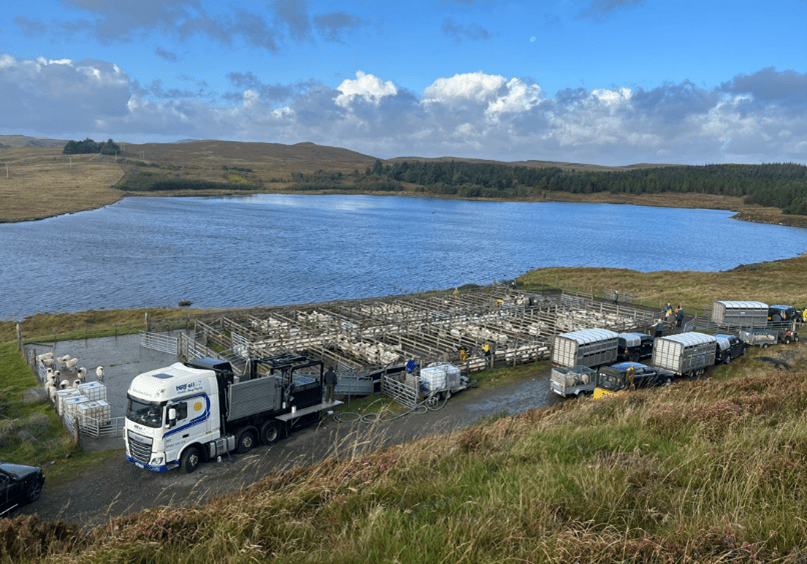
Roundworms are an ongoing problem for crofters. Control often relies on routine treatment with wormers (anthelmintics), given on set dates throughout the year. Roundworms are increasingly becoming resistant to these products, making control challenging. More targeting wormer use improves control and slows the development of resistance. Faecal egg counts can inform the timing of treatment and check if the treatment was effective. As testing was not available in Lewis and Harris, few crofters were using this, and posting samples to the mainland resulted in a delay in getting results. Problems collecting samples from common grazings was also a deterrent. This prompted discussions around simplified sample collection, pooled testing and the potential of township-level control. Free faecal egg count testing was made available on the island for a year using FECPAK machines (Techion), with the aim of showing the benefits of frequent testing to improve roundworm management.
Collective action to improve sheep disease treatment approaches
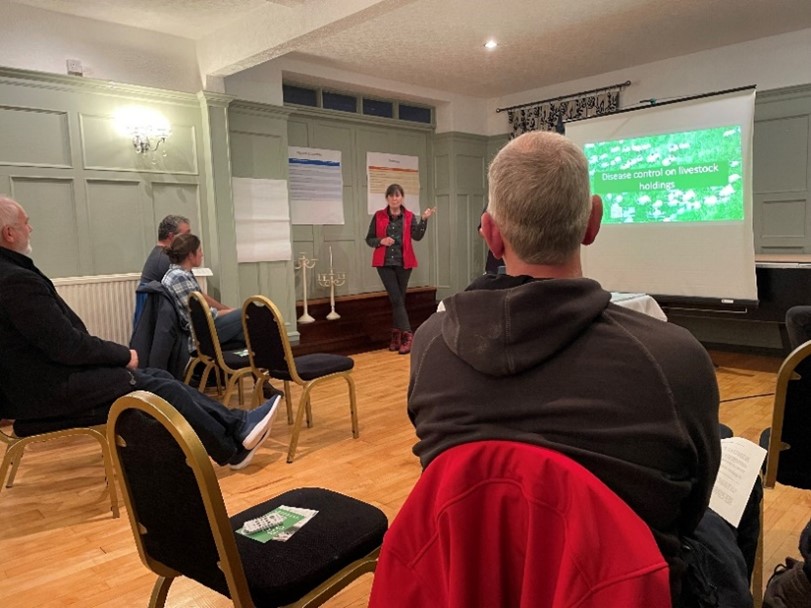
A total of eleven in-person workshops and one online workshop were held with crofters in Lewis and Harris between 2022 and 2024. These explored current disease control measures, practices crofters intend to implement soon, and those that would be challenging to put in place. The groups also discussed collaborative working on disease control, and the barriers to crofters when implementing industry recommendations around sheep disease control.
The participants highlighted that there was a lack of coordinated collaboration between some communities, with fewer ‘gathers’ – times when townships worked together to bring all the sheep off the moors – than in the past. Due to the nature of crofting, participants often don’t have the time to spend on extra disease control measures. When they do have time, they frequently don’t have the necessary infrastructure, such as sheep dips and fanks, to put these activities into practice. Fences, vital to isolate sick sheep and prevent different flocks mixing, is often in poor repair and too expensive to replace. In some cases it is not practical to put up fences, e.g., in areas of common grazing land. It was also noted that much of the advice on sheep disease control was not specific enough to the geography and climate of the islands and not sensitive enough of the practicalities of crofting.
Participants in the workshops reflected on the benefits of the sheep dipping campaign, both for the improved health of the sheep and the improved social life of the crofting communities. They felt that this would reignite interest in more frequent sheep gathers and other social events based on sheep keeping, kick-starting the development of sustainable, community-level sheep disease control practices. Follow-up interviews with some of the crofters indicate that certain townships are already moving forward in putting these plans into place.
Cross-island collaboration
The crofters on Lewis and Harris mentioned that they were interested in learning more about the procedures put in place to control farm animal disease on Shetland as part of the Shetland Animal Health Scheme. The researchers developed a ‘virtual tour’ to aid in this and shared the link with the crofters on Lewis and Harris. The virtual tour is a valuable tool to illustrate the ways in which the farming community in Shetland is working to control farm animal disease risks coming from imported animals. It is hoped that this will inspire other crofters on different islands and suggests that there is scope for these communities to develop their own, similar disease control schemes in the future.
In addition, in 2024 after exploring the virtual tour key crofting stakeholders from Lewis and Harris visited Shetland with researchers from the James Hutton Institute to explore the scheme firsthand, meet Shetland stakeholders and discuss what elements could potentially work for disease control on their islands.

Power of the interventions
The various interventions and activities described above have led to renewed understandings and forged new social and working relationships between the crofters, as well as between crofting communities and industry experts. During the workshops local crofters recalled the benefits of working together, and newcomers to crofting mentioned experiencing the power of collective action for the first time, with some stating that sheep scab could only be effectively controlled via these collective actions. The crofters hope this is the start of a journey that can lead to a sheep scab free island flock and better roundworm control.
Controlling sheep scab and roundworms are currently a priority for the crofters on Lewis and Harris. As the collaborative way of working gathers momentum and the benefits of this are seen, the control of other sheep diseases might be considered, leading to additional benefits of the project. It will be interesting to follow this journey to identify the advantages of returning to more traditional ways of working. This project has shown the power and effectiveness of bringing people together to collaborate on a shared goal – both in person and virtually, to build a more sustainable future.
Next steps for the research
Next steps will see further collaborations as a ‘pan-island network’ will be initiated to allow experiences on disease control to be shared between farmers and crofters on Shetland, Orkney and Lewis and Harris. Further workshops as well as a joint meeting will be held to aid in forging relationships and building learnings around controlling sheep disease on islands.
Acknowledgements
We would like to thank all the crofters and others who have taken part in the activities conducted as part of this project, as well as for their on-going interest and involvement in the research as it continues to evolve in the future.
For more information please contact
For general enquiries: Claire Hardy (Claire.hardy@hutton.ac.uk)
For enquiries about sheep scab: Stew Burgess (stewart.burgess@moredun.ac.uk)
For enquiries about roundworms: Dave Bartley (dave.bartley@moredun.ac.uk) and Lynsey Melville (lynsey.melville@moredun.ac.uk)
 Scottish Islands Research Network
Leave a comment